

The tax function is entering a major digital transformation. Periodic reporting, spreadsheets, manual reconciliations and disconnected data sources are becoming harder to sustain as tax authorities adopt e-invoicing, digital reporting, continuous transaction controls and advanced analytics. At the same time, artificial intelligence is changing how finance and tax teams process information, identify exceptions and manage workflows. At Efficacité Global, we believe the modern tax function should connect AI, automation, trusted data, finance systems and human expertise to create faster, more accurate and more proactive operations.
What Is Real-Time Tax?

Real-time tax is an approach in which tax information is captured, validated, analyzed and managed much closer to the point where business transactions occur. It allows organizations to identify potential problems earlier rather than waiting until the end of a reporting period.
Digital reporting and continuous transaction models are already pushing tax processes closer to transaction-level activity in many jurisdictions.
| Traditional model | Modern digital model |
|---|---|
| Transaction → Data collection → Reconciliation → Tax calculation → Filing | Transaction → Data capture → AI/automation → Validation → Exception detection → Action |
Why Tax Transformation Matters Now
Tax teams are navigating greater regulatory complexity, growing transaction volumes, fragmented enterprise systems and pressure to reduce manual work. Many departments still spend substantial time collecting, validating and reconciling information by hand.
The opportunity is not simply to accelerate the existing process. Organizations can redesign the tax operating model itself.
- Increasing digital-reporting requirements
- Rapid e-invoicing adoption
- Greater demand for transparency
- Fragmented finance and operational systems
- Pressure to improve accuracy and productivity
- Growing interest in AI and intelligent automation
AI-Powered Tax Transformation
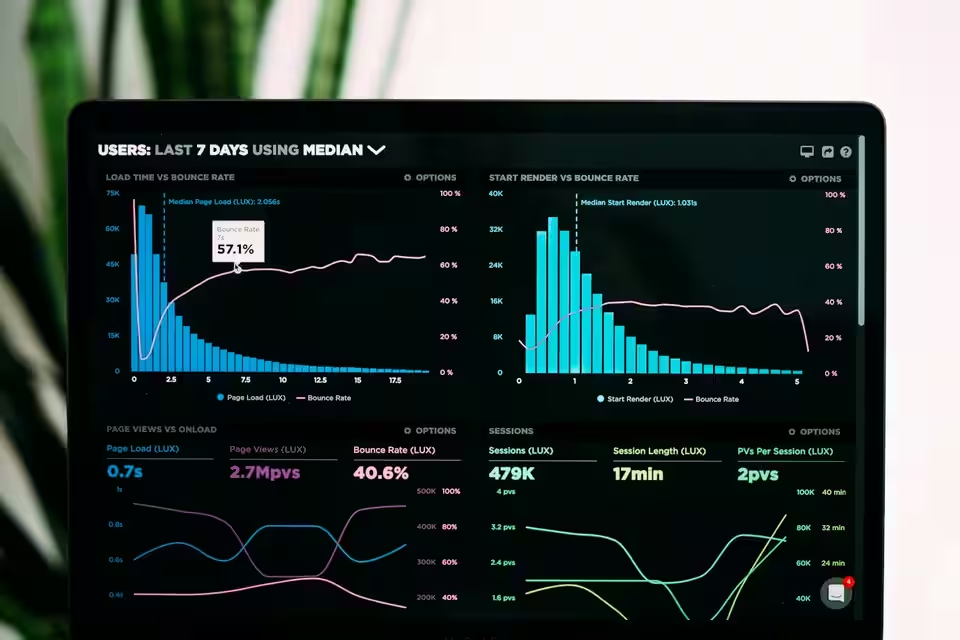
Artificial intelligence can support tax teams across data classification, document analysis, transaction monitoring, anomaly detection, research, reconciliation, reporting and risk analysis.
The objective is not to remove tax professionals from the process. It is to let technology handle appropriate high-volume, repetitive work while professionals focus on judgment, strategy, risk and complex matters.
- Tax-data classification and document analysis
- Transaction monitoring and anomaly detection
- Reconciliation and compliance workflows
- Tax research and knowledge management
- Reporting, risk analysis and exception management
From Rules to Intelligent Tax Workflows
Traditional automation typically follows predefined rules: a transaction type triggers a tax rule and a fixed workflow. AI-enabled automation can add contextual analysis and help teams move from simple task execution toward intelligent tax operations.
A more advanced workflow can capture information, understand context, validate data, identify exceptions, recommend a response and escalate the issue when professional review is required.
"Capture → Understand → Validate → Analyze → Identify exception → Recommend → Escalate"
Trusted Tax Data Is the Foundation

AI cannot compensate for unreliable data. When tax information is spread across ERP systems, accounting platforms, procurement software, spreadsheets, billing tools, CRM platforms and legacy applications, creating a consistent view becomes difficult.
A modern tax-data strategy should prioritize accuracy, consistency, accessibility, governance and traceability. Better data enables better AI—and better AI can support faster tax decisions.
- Clear ownership and common definitions
- Standardized transaction and master data
- Traceable sources and transformations
- Role-based access and security
- Ongoing quality monitoring and issue resolution
E-Invoicing and Continuous Tax Compliance
E-invoicing creates structured transaction information that can be validated and processed electronically. It increases the importance of accurate tax codes, correct classifications, supplier and customer data quality, automated validation, system integration, digital reporting and audit trails.
E-invoicing is therefore not merely an accounts-payable or billing project. It is part of a broader tax-data transformation. In a continuous model, teams capture, validate, monitor, detect, correct and report throughout business operations instead of asking only whether the next filing is ready.
| Periodic compliance | Continuous compliance |
|---|---|
| Collect → Reconcile → Prepare → File | Capture → Validate → Monitor → Detect → Correct → Report |
Real-Time Tax Risk Management
AI and analytics can help identify unusual transactions, duplicate records, incorrect classifications, missing information, data inconsistencies and unexpected patterns. Rather than reviewing every transaction manually, tax professionals can concentrate on exceptions and higher-risk activity.
This targeted model can improve responsiveness while preserving professional review for material issues.
- Unusual or duplicate transactions
- Incorrect tax classifications
- Missing supporting information
- Data inconsistencies across systems
- Unexpected patterns and potential compliance exceptions
AI Agents and Tax Operations
Agentic AI can potentially perform several connected steps within an authorized workflow: retrieve transaction data, review supporting documents, identify a potential issue, research applicable rules, prepare an explanation, route the matter to the appropriate professional and record the outcome.
For material or complex decisions, human review remains essential. The emerging model combines an AI agent, trusted data, tax expertise and human governance.
"AI agent + trusted data + tax expertise + human governance"
Tax and Finance Are Becoming More Connected

Tax information is connected to accounting, procurement, sales, supply chain, payroll, treasury, financial reporting and business operations. As reporting becomes more digital and transaction-based, tax increasingly needs to be integrated into finance and enterprise data architecture.
Tax transformation should therefore be considered as part of broader finance transformation, digital transformation and data transformation—not as an isolated compliance project.
The Future Tax Workforce
Technology can reduce time spent gathering data, preparing spreadsheets, reconciling records and performing repetitive reporting. Tax professionals can then dedicate more attention to strategy, risk management, business advisory, complex transactions, regulatory interpretation, scenario analysis and AI oversight.
The future capability mix combines tax expertise, data literacy, AI literacy and business knowledge.
- Tax strategy and complex transactions
- Risk management and regulatory interpretation
- Business advisory and scenario analysis
- AI oversight, controls and decision support
How to Build a Real-Time Tax Function
Organizations can approach the transformation in measured steps, beginning with the current operating reality and scaling only when the foundations are ready.
- Map current processes: identify manual activities, systems, data sources and bottlenecks.
- Identify data problems: find duplicate, inconsistent or inaccessible tax information.
- Create a trusted data foundation: standardize information, ownership and governance.
- Automate repetitive activities: begin with high-volume, rules-based processes.
- Introduce AI selectively: apply it to classification, analysis, research, exceptions and decision support.
- Connect enterprise systems: integrate tax with finance, ERP, procurement and relevant operational tools.
- Establish governance: define security, access, auditability, monitoring and human approvals.
- Measure business value: track efficiency, accuracy, risk reduction and compliance performance.
Measuring AI and Tax Transformation
Technology adoption alone is not enough. Leaders should measure operational, risk and financial outcomes rather than the number of tools deployed.
| Metric | What it shows |
|---|---|
| Automation rate | Reduction in manual work |
| Tax-data accuracy | Quality of underlying information |
| Exception rate | Process effectiveness |
| Resolution time | Responsiveness |
| Reconciliation time | Operational efficiency |
| Reporting cycle time | Speed |
| Compliance errors | Risk reduction |
| Manual hours | Workforce efficiency |
| Cost per process | Financial impact |
| AI-assisted workflows | Digital maturity |
The Real-Time Tax Operating Model
The future tax function can be understood through five connected capabilities. Together, they create intelligent tax operations.
| Capability | Role |
|---|---|
| Data | Reliable, standardized and accessible tax information |
| AI | Intelligent analysis, classification and decision support |
| Automation | Fast execution of repetitive and rules-based processes |
| Governance | Security, controls, accountability and human oversight |
| People | Judgment, strategy and business context |
Building Tax for an AI-Powered Business Environment
At Efficacité Global, we believe tax transformation is becoming an important component of the intelligent enterprise. The opportunity extends beyond automating compliance: data creates visibility, AI creates intelligence, automation creates speed, people provide judgment and governance creates trust.
The question is no longer only how to prepare tax reports faster. It is how to build a tax function ready for a real-time, AI-powered business environment. Schedule a conversation about creating a practical transformation roadmap.
Key Takeaways
- ✓Real-time tax moves validation, monitoring and issue resolution closer to the underlying transaction.
- ✓AI should augment professional judgment by handling appropriate high-volume work and highlighting exceptions.
- ✓Trusted, governed and traceable data determines whether tax automation can scale reliably.
- ✓E-invoicing and continuous reporting require tax to connect more closely with finance and enterprise systems.
- ✓Agentic AI requires authorization boundaries, auditability and human review for material decisions.
- ✓Transformation success should be measured through accuracy, speed, risk reduction, productivity and cost.
Frequently Asked Questions
What is real-time tax?
Real-time tax is a digital approach in which tax data, transactions and compliance activities are monitored and managed closer to the time business transactions occur.
How is AI transforming tax?
AI can support tax-data analysis, classification, research, reconciliation, anomaly detection, reporting and workflow automation.
What is AI tax automation?
AI tax automation combines artificial intelligence with tax workflows to reduce repetitive manual work and support faster analysis and decision-making.
How does e-invoicing affect tax?
E-invoicing creates structured transaction data and can require businesses to improve tax-data accuracy, validation, integration and digital reporting.
What is continuous tax compliance?
Continuous tax compliance means monitoring and validating tax information throughout business operations rather than relying primarily on periodic reviews and filings.
What is agentic AI in tax?
Agentic AI in tax refers to systems that can execute multiple connected steps within authorized workflows while escalating complex decisions to tax professionals.
Will AI replace tax professionals?
AI can automate certain activities, but tax professionals remain essential for judgment, strategy, complex transactions, interpretation and accountability.
Why is tax data important for AI?
AI depends on reliable information. Accurate, consistent and accessible tax data provides the foundation for effective automation and AI-powered tax operations.
About the author
Efficacité Global Team
Tax Transformation, AI & Data Advisory
Efficacité Global partners with growing businesses and nonprofits across the U.S. and U.K. on CPA, tax, finance transformation, and outsourced operations. Our team publishes practical guidance drawn from live client engagements.
Talk to a CPA or consultant
Want to apply this to your business? Book a free 30-minute discovery call with an Efficacité Global partner and get tailored guidance for your next step.
Book a free consultation