

The global airline industry is facing fuel-price volatility, inflation, rising labor and maintenance costs, aircraft delivery delays, changing passenger demand and operational disruption. At the same time, artificial intelligence is moving from experimentation into practical operations. The challenge for airline leaders is no longer simply whether to invest in technology, but how to use AI and digital transformation to improve profitability, resilience, customer experience and long-term competitiveness. At Efficacité Global, we believe the next phase of aviation transformation will combine AI, data, automation, operational intelligence and human expertise.
The Airline Industry Is Entering a New Operating Environment

Airline executives are balancing immediate financial pressure with long-term technology investment. A 2026 global airline CEO survey of 21 airline CEOs found that cost control and financial health had become major strategic priorities, while transformative technology had also risen in importance. Fuel costs, inflation, aircraft delivery delays and margin pressure were among the significant challenges identified.
The airlines that connect financial discipline, capacity management, technology modernization and operational resilience can create a more data-driven operating model.
- Protect margins and control costs
- Improve operational efficiency and resilience
- Manage capacity and optimize revenue
- Modernize technology while continuing to invest for the future
AI Is Becoming a Core Airline Technology
Artificial intelligence is moving from an experimental technology to an operational capability. The 2026 survey identified AI and machine learning as the leading technology-investment priority among the airline CEOs surveyed.
The practical test is whether an AI use case creates measurable value across revenue, cost, reliability, safety, productivity or customer outcomes.
- Revenue management and dynamic pricing
- Fuel and flight optimization
- Airport and ground operations
- Predictive maintenance
- Disruption management and customer service
- Workforce productivity and network planning
AI-Powered Revenue Management

Airlines operate with highly perishable inventory: once a flight departs, an empty seat cannot be sold. AI can analyze historical demand, booking behavior, route performance, passenger segments, competitive pricing, seasonality, capacity and market conditions to support more responsive pricing and revenue decisions.
More than 80% of respondents in the cited 2026 survey identified revenue management and dynamic pricing as a significant AI application. The broader opportunity is a shift from static analysis toward real-time revenue intelligence.
AI and Airline Cost Optimization
Airline profitability is highly sensitive to operating costs. AI can help identify opportunities to reduce avoidable cost while improving operational performance. The objective is not simply to cut spending, but to make each operational decision more intelligent.
| Opportunity | How AI can support it |
|---|---|
| Fuel | Analyze operational and environmental information for more efficient decisions |
| Ground operations | Optimize turnaround, staffing, equipment and airport processes |
| Maintenance | Identify potential requirements before failures occur |
| Workforce | Reduce repetitive administration and improve information access |
| Network | Analyze routes, schedules, capacity and operational constraints |
The Rise of Agentic AI in Aviation
The next stage of aviation AI may move beyond systems that only analyze information. Agentic AI can potentially monitor conditions, identify an issue, evaluate options, recommend a response, initiate approved workflow steps, coordinate information across systems and escalate complex decisions.
Its potential progression is predictive AI → prescriptive AI → agentic AI. Because aviation is safety-critical, greater autonomy must be matched by stronger authorization, security, monitoring, regulatory compliance and human oversight.
"Agentic does not mean autonomous without limits. In aviation, every action needs appropriate boundaries and accountability."
AI for Airline Disruption Management
A delayed aircraft can affect crew schedules, connecting passengers, aircraft rotations, gates, baggage operations, customer service and subsequent flights. AI can analyze these interconnected variables and help teams identify response options faster.
Future systems may follow a controlled sequence: detect → analyze → predict → recommend → coordinate → escalate. Human decision-makers remain essential for complex or high-impact situations.
Predictive Maintenance and Fleet Intelligence
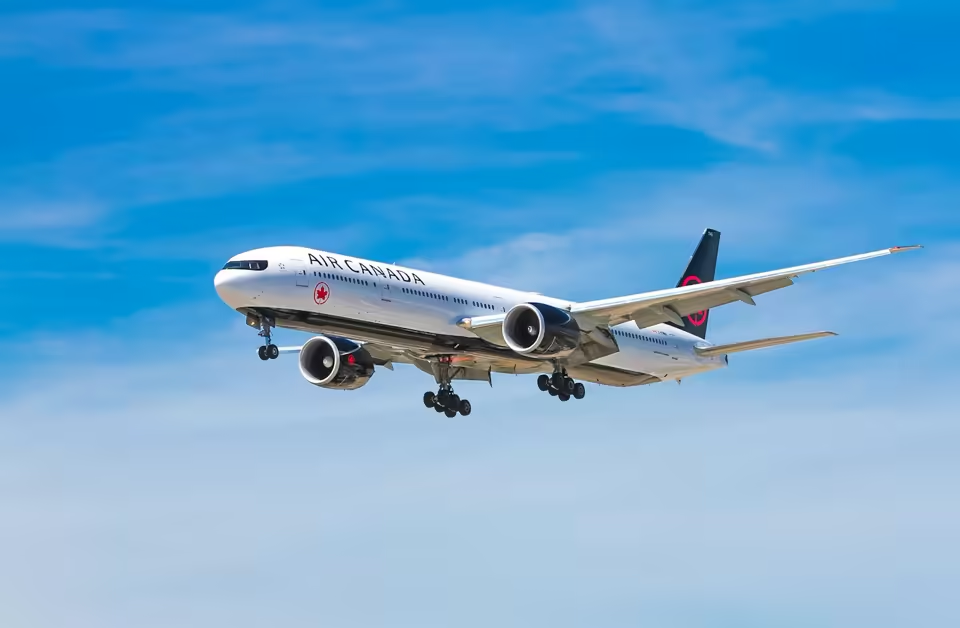
Airlines can combine aircraft sensor data, maintenance history, component performance, flight cycles, environmental conditions and operating patterns to identify signals associated with potential component issues.
The goal is not to replace maintenance expertise. It is to give professionals better information earlier.
- Better maintenance and parts planning
- Fewer unexpected operational disruptions
- Improved aircraft availability
- More effective maintenance workforce utilization
AI and Airport Operations
Airline performance is closely connected to airport operations. AI can support gate allocation, ground handling, baggage operations, passenger flow, turnaround management, staffing and equipment utilization.
For airlines operating hundreds or thousands of flights, small improvements in individual decisions can accumulate into meaningful network-wide gains.
AI-Powered Customer Experience
AI can assist with flight information, booking questions, rebooking, baggage information, disruption notifications, personalized communications and loyalty interactions. Generative AI and AI agents can create more conversational service while connecting passengers with relevant operational information.
Customer experience should not become entirely automated. Complex, emotional or high-value situations may still require human intervention.
Airline Data Is Becoming a Strategic Asset
Airlines generate enormous volumes of flight, aircraft, passenger, booking, revenue, maintenance, airport, crew, fuel, weather and customer-interaction data. AI is only as effective as the data supporting it.
Legacy systems, fragmented environments, inconsistent standards and integration challenges can limit AI value. Airline AI transformation is therefore also a data transformation and governance challenge.
The Importance of Legacy Technology
One of the biggest barriers to airline AI adoption may be the existing technology environment rather than the AI itself. Airlines often operate complex ecosystems developed over many years.
AI initiatives may require coordinated work across data integration, APIs, cloud infrastructure, security, governance and modernization. Before deploying sophisticated agents, airlines need to understand how those systems will interact safely with existing operational technology.
AI Workforce and Human-AI Collaboration
AI can help airline employees spend less time on repetitive activities and more time on decisions, customer relationships, operational problem-solving, safety, exception management and planning. The cited survey identified AI productivity tools and workforce upskilling or reskilling as major talent priorities.
Technology investment and workforce development need to advance together. The future airline workforce may increasingly combine human experts, AI copilots, digital workers and governed AI agents.
- Decision-making and exception management
- Customer relationships and service recovery
- Operational problem-solving and safety
- Strategic planning and continuous improvement
The New Airline Operating Model
Traditional airline operations are often organized around departments and specialized systems. A more connected model can link data → AI → decision → action → feedback.
For example, passenger-demand data can feed AI revenue analysis, produce a pricing recommendation, trigger human approval or an authorized action, record the revenue result and improve future analysis. This creates a continuous intelligence loop.
| Stage | Purpose |
|---|---|
| Data | Create a trusted view of demand and operations |
| AI | Analyze patterns, constraints and opportunities |
| Decision | Apply business rules and human judgment |
| Action | Execute within approved systems and limits |
| Feedback | Measure outcomes and improve future decisions |
Sustainability and AI in Aviation
AI can help airlines identify operational opportunities involving fuel, flight paths, ground efficiency, fleet utilization, emissions monitoring and sustainable aviation fuel planning.
Technology is only one part of aviation sustainability. Fleet modernization, infrastructure, fuel availability, operating practices and industry-wide investment also matter.
What Airline Leaders Should Do Now
Airlines can begin with a practical, controlled sequence that connects technology investment to business value.
- Identify the business problem: start with a measurable challenge rather than technology for its own sake.
- Find high-value use cases: prioritize revenue, fuel, operations, maintenance or productivity opportunities.
- Improve data foundations: make relevant information reliable, accessible and governed.
- Modernize integration: connect AI securely with the enterprise systems it needs.
- Define human oversight: decide which actions can be automated and which require approval.
- Establish AI governance: address security, privacy, compliance, safety, accountability and monitoring.
- Train the workforce: develop employees who understand both technology and airline processes.
- Measure ROI: track cost, revenue, efficiency, reliability and customer outcomes.
The Future of Aviation Is Intelligent, Connected and Human
AI can help airlines optimize revenue, reduce waste, improve operations, support employees, serve customers, analyze complex data and respond to disruption. Successful transformation, however, requires more than deploying models. It requires strategy + data + technology + people + governance.
At Efficacité Global, we believe the future of aviation will be shaped by organizations that connect AI investment directly to measurable business outcomes. The strategic question is no longer whether airlines should use AI, but where AI can create measurable value across the airline. Talk to our team about turning that opportunity into an operating roadmap.
Key Takeaways
- ✓Airline competitiveness increasingly depends on linking cost discipline with technology modernization.
- ✓Revenue management, maintenance, disruption response and operational efficiency are leading AI opportunities.
- ✓Agentic AI requires strong controls and human oversight in safety-critical environments.
- ✓Connected, high-quality data and modern integration determine whether AI can scale.
- ✓The strongest customer model combines AI speed with human empathy and judgment.
- ✓Airlines should measure AI through business outcomes and build workforce capability alongside technology.
Frequently Asked Questions
How is AI transforming the airline industry?
AI is being applied across revenue management, dynamic pricing, fuel optimization, airport operations, maintenance, customer service, disruption management and workforce productivity.
What is AI in aviation?
AI in aviation includes artificial intelligence, machine learning, generative AI and agentic AI used to analyze data, support decisions, automate suitable workflows and improve airline operations.
How can AI improve airline profitability?
AI can support revenue optimization, pricing, cost control, fuel efficiency, maintenance planning, workforce productivity and better utilization of aircraft and network capacity.
What is AI-powered revenue management?
It uses data and machine-learning techniques to analyze demand, pricing, capacity and market conditions in support of airline pricing and revenue decisions.
What is agentic AI in aviation?
Agentic AI refers to systems that can take multiple authorized steps toward a defined objective. Aviation use requires strong safety, security, governance and human-oversight controls.
Can AI improve airline customer service?
Yes. AI can answer routine questions, provide flight information, support rebooking and deliver disruption updates, while complex cases are escalated to people.
Why is airline data important for AI?
Effective AI depends on reliable, connected operational, customer, financial, aircraft and maintenance data. Fragmented or low-quality data limits accuracy and value.
What are the biggest barriers to airline AI adoption?
Common barriers include legacy technology, data integration, AI skill shortages, organizational resistance, cybersecurity, governance and the complexity of integrating AI into operational environments.
About the author
Efficacité Global Team
Aviation, AI & Operations Advisory
Efficacité Global partners with growing businesses and nonprofits across the U.S. and U.K. on CPA, tax, finance transformation, and outsourced operations. Our team publishes practical guidance drawn from live client engagements.
Talk to a CPA or consultant
Want to apply this to your business? Book a free 30-minute discovery call with an Efficacité Global partner and get tailored guidance for your next step.
Book a free consultation