

Accounts payable has traditionally been viewed as a transactional back-office process. Today, that is changing. Increasing invoice volumes, evolving compliance requirements, electronic invoicing, supplier-data challenges, rising automation capabilities and demand for real-time financial information are pushing organizations to rethink how accounts payable operates. For finance leaders, the opportunity goes beyond processing invoices faster. Modern AP can become a source of financial control, data quality, cash-flow visibility and business intelligence. At Efficacité Global, we help organizations explore how finance transformation, automation, data and intelligent technologies can create more scalable and efficient accounts payable operations.
What Is Outsourced Accounts Payable?
Outsourced accounts payable is a finance operating model in which an organization engages an external specialist to manage some or all of its AP processes. Depending on the organization's requirements, a provider may support invoice processing, data capture, validation, purchase-order matching, supplier management, coding, approvals, exception management, reconciliations, supplier inquiries, payment support, reporting and data-quality management.
The objective is not simply to transfer administrative work to a third party. A well-designed AP outsourcing model can provide process standardization, operational scalability, stronger controls, better data quality and greater visibility into financial activity.
- Invoice capture, validation and coding
- Purchase-order matching and approval workflows
- Supplier management and inquiry resolution
- Exception management and reconciliations
- Payment support, reporting and data-quality management
Why Accounts Payable Is Becoming a Strategic Finance Function
Every invoice contains valuable financial information: who the organization purchases from, what it buys, how much it spends, which department is responsible, which contract or purchase order applies, when payment is due, what tax treatment may apply and whether the purchase followed policy.
When this information is accurate and connected, accounts payable becomes more than an administrative process. It becomes a source of financial intelligence for CFOs and finance leaders.
Accounts Payable Compliance and Data Quality
Compliance is an essential part of accounts payable. Organizations need processes that help ensure invoices are captured, validated, approved, recorded and retained appropriately. But compliance alone does not guarantee high-quality financial data.
An invoice can meet basic requirements while still containing incorrect supplier details, duplicate records, poor cost-center coding, missing purchase-order information, incorrect tax classifications, unresolved exceptions or inconsistent descriptions. Finance leaders need information that is compliant, accurate, standardized, connected and usable for analysis.
"Compliant data is not always decision-ready data."
How AP Outsourcing Can Improve Data Quality
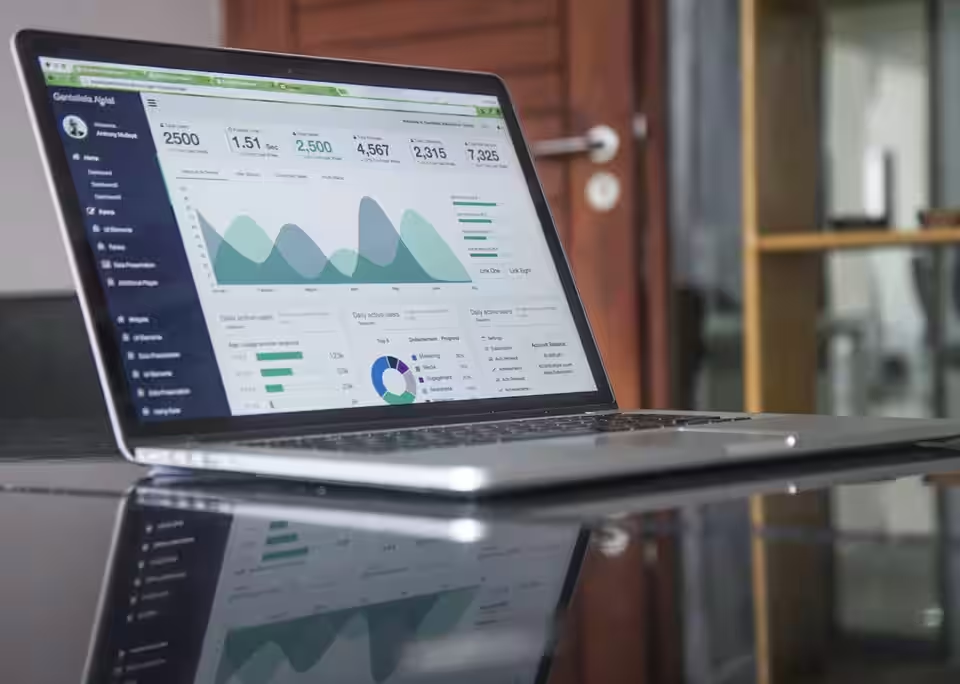
One potential advantage of accounts payable outsourcing is dedicated process ownership. An experienced AP operation can establish consistent procedures across the invoice lifecycle and create a more reliable foundation for financial reporting and analysis.
- Maintain accurate supplier master data and reduce duplicate or incomplete records.
- Validate invoice information before transactions enter the financial workflow.
- Connect invoices with purchase orders and receipts where applicable.
- Identify exceptions and route them to the appropriate business owner.
- Apply consistent entity, department, account and cost-center coding.
- Report on processing activity, aging, exceptions and AP performance.
AP Automation: More Than Faster Invoice Processing
Accounts payable automation can reduce repetitive manual work across invoice capture, data extraction, duplicate detection, purchase-order matching, workflow routing, approval notifications, exception identification, payment-status reporting and supplier communication.
Automation should not be treated as a substitute for process design. If supplier data is poor or approval rules are inconsistent, adding automation may simply make existing problems happen faster.
AI and the Future of Accounts Payable

Artificial intelligence adds another dimension to AP automation. AI can potentially help finance teams identify patterns, classify information, detect anomalies, extract invoice data, assist with exceptions and find relevant information.
An AI-enabled AP workflow could identify an invoice, understand its contents, compare it with purchasing information, detect an exception and route the issue to the right person. The objective is not to remove people, but to let them spend more time on judgment, exceptions, supplier relationships, controls and financial decisions.
E-Invoicing and Accounts Payable
As governments and businesses expand electronic invoicing requirements, organizations need to consider how invoice data enters their financial systems and how it is validated and managed. For UK organizations, mandatory e-invoicing requirements are being introduced on a phased basis, with further implementation details subject to government developments.
Preparing for e-invoicing involves supplier readiness, invoice-data standards, tax information, ERP integration, approval workflows, purchase-order matching, retention, audit trails, exception management and clear internal ownership. E-invoicing is not simply a technology project; it is also a finance-process and data-management project.
Turning AP Data Into Financial Intelligence
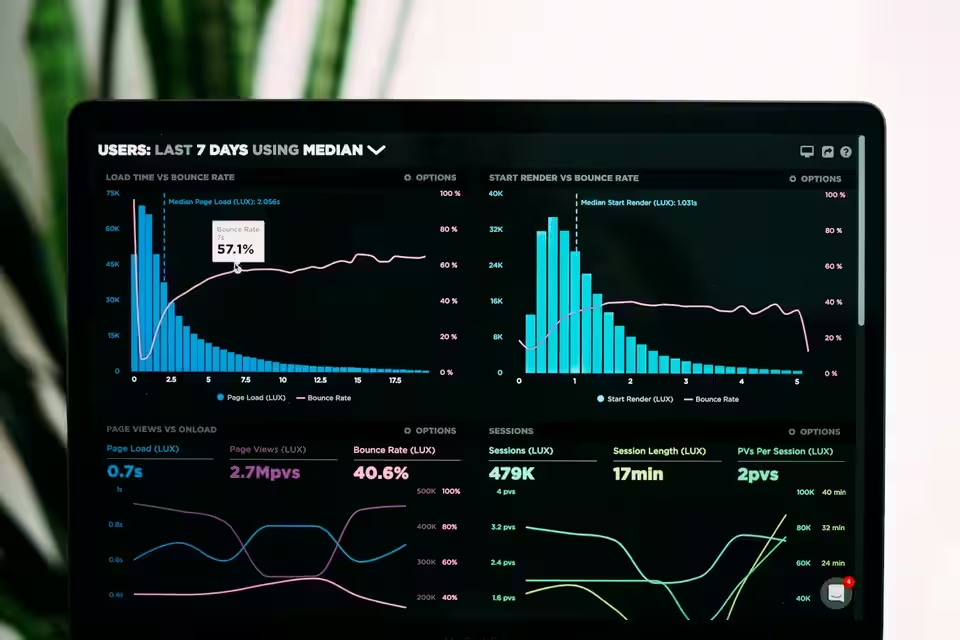
The greatest opportunity may be what organizations can learn from AP data. When accounts payable information is connected with procurement, budgets, contracts, supplier records and cash-flow information, finance teams gain better visibility into spending and process performance.
- Analyze spending by supplier, category, department, entity or location.
- Use invoice and payment-term information to improve cash-flow visibility.
- Identify recurring approval, matching, coding or supplier-data problems.
- Detect potential duplicate invoices or supplier records.
- Analyze invoice aging and approvals to locate bottlenecks.
- Use supplier and spend patterns to inform sourcing and procurement decisions.
Accounts Payable and Cash-Flow Management
AP is closely connected to working capital. Accurate information about outstanding invoices, due dates, supplier terms, approved liabilities, unprocessed invoices, cash requirements and early-payment opportunities gives finance leaders better visibility for cash-flow decisions.
Better AP data does not automatically improve cash flow, but it can provide the information needed to manage payment timing and working capital more deliberately.
What Should Organizations Outsource?
Not every organization needs to outsource its entire AP function. A company may outsource specific activities such as invoice processing, data entry, supplier queries, exception management, reporting or reconciliations. Alternatively, it may outsource the broader operating function while retaining strategic financial authority internally.
The right model depends on transaction volume, internal capabilities, technology, geographic complexity, control requirements and growth plans.
Outsourcing AP Without Losing Control
A well-designed outsourcing model separates operational execution from financial authority. The organization can retain responsibility for financial policy, payment authorization, supplier strategy, material exceptions, working-capital objectives, risk management and internal controls. The external provider manages defined operational activities within those parameters.
"Outsource the process. Keep strategic accountability."
Measuring AP Outsourcing Performance
A successful outsourced AP program should be measurable. Clear indicators let finance leaders evaluate whether transformation is creating operational and financial value.
| KPI | What it measures |
|---|---|
| Invoice processing time | Processing efficiency |
| First-time-right rate | Data and process quality |
| Exception rate | Process accuracy |
| Exception aging | Resolution performance |
| Duplicate invoice rate | Financial control |
| Supplier query resolution | Service quality |
| Approval cycle time | Workflow efficiency |
| Cost per invoice | Operating efficiency |
| SLA performance | Provider performance |
The Human Role in Modern AP
Technology and outsourcing do not eliminate the need for finance professionals. They change where people spend their time. Instead of manually processing routine transactions, professionals can focus on analysis, exceptions, risk, supplier relationships, controls, process improvement, working capital and strategic decisions.
How to Modernize Your Accounts Payable Function

Organizations can begin AP transformation with a structured sequence that connects operational realities to measurable outcomes.
- Assess the current AP process: understand how invoices are received, processed, approved, recorded and paid.
- Analyze the data: review supplier records, invoice information, duplicates, coding accuracy and exception patterns.
- Identify manual activities: determine which repetitive processes could benefit from automation.
- Review compliance requirements: understand applicable tax, e-invoicing, audit, documentation and internal-control requirements.
- Establish KPIs: measure speed, quality, cost, exceptions, compliance and financial outcomes.
- Evaluate outsourcing: determine which processes could benefit from specialist external support.
- Introduce AI strategically: identify areas for classification, extraction, anomaly detection, analysis and workflow management.
The Future of Outsourced Accounts Payable
The future of AP is not simply about processing more invoices at a lower cost. It is about creating a finance function that provides better information, stronger controls, greater scalability and more intelligent decision support. Outsourcing provides operational expertise, automation reduces repetitive work, AI adds intelligence, data governance improves reliability, and finance professionals provide the judgment and accountability technology cannot replace.
At Efficacité Global, we help organizations explore finance transformation strategies that combine people, process, technology, automation and data. Our approach focuses on practical improvements to finance operations, including AP transformation, process optimization, automation, data quality and intelligent finance. Connect with our team to explore a more scalable, automated and data-driven AP operating model.
"Efficiency. Compliance. Data quality. Visibility. Intelligence."
Key Takeaways
- ✓AP outsourcing is an operating-model decision, not simply a labor-arbitrage exercise.
- ✓Reliable supplier, invoice and coding data is the foundation for automation and useful analytics.
- ✓Organizations should standardize processes and controls before scaling automation.
- ✓AI can augment AP teams, while human oversight remains essential for judgment and accountability.
- ✓Strategic authority, payment approval and risk ownership can remain internal in an outsourced model.
- ✓KPIs should measure speed, quality, controls, service and cost together.
Frequently Asked Questions
What is outsourced accounts payable?
Outsourced accounts payable is a model where an external specialist manages some or all AP activities, including invoice processing, validation, matching, supplier queries, reporting and exception management.
What are the benefits of AP outsourcing?
AP outsourcing can help organizations improve scalability, standardize processes, reduce manual workload, strengthen data quality, improve operational visibility and access specialist capabilities.
How does AP outsourcing support compliance?
A structured AP operation can establish consistent procedures for invoice validation, approvals, documentation, data management and audit trails.
Can AI automate accounts payable?
AI can support invoice-data extraction, classification, anomaly detection, exception identification and workflow assistance. The appropriate level of automation depends on the organization's systems, controls and requirements.
What is the difference between AP automation and AP outsourcing?
AP automation uses technology to automate activities. AP outsourcing uses an external provider to perform defined activities. Organizations can use either independently or combine outsourcing with automation and AI.
How does accounts payable affect cash flow?
AP contains information about outstanding liabilities, payment dates, supplier terms and upcoming obligations. Accurate AP data gives finance teams better visibility for working-capital and cash-flow planning.
Is outsourced accounts payable secure?
Security depends on the provider, technology architecture, access controls, data-protection practices and governance framework. Organizations should complete appropriate due diligence before selecting a provider.
About the author
Efficacité Global Team
Finance Transformation & Operations Advisory
Efficacité Global partners with growing businesses and nonprofits across the U.S. and U.K. on CPA, tax, finance transformation, and outsourced operations. Our team publishes practical guidance drawn from live client engagements.
Talk to a CPA or consultant
Want to apply this to your business? Book a free 30-minute discovery call with an Efficacité Global partner and get tailored guidance for your next step.
Book a free consultation