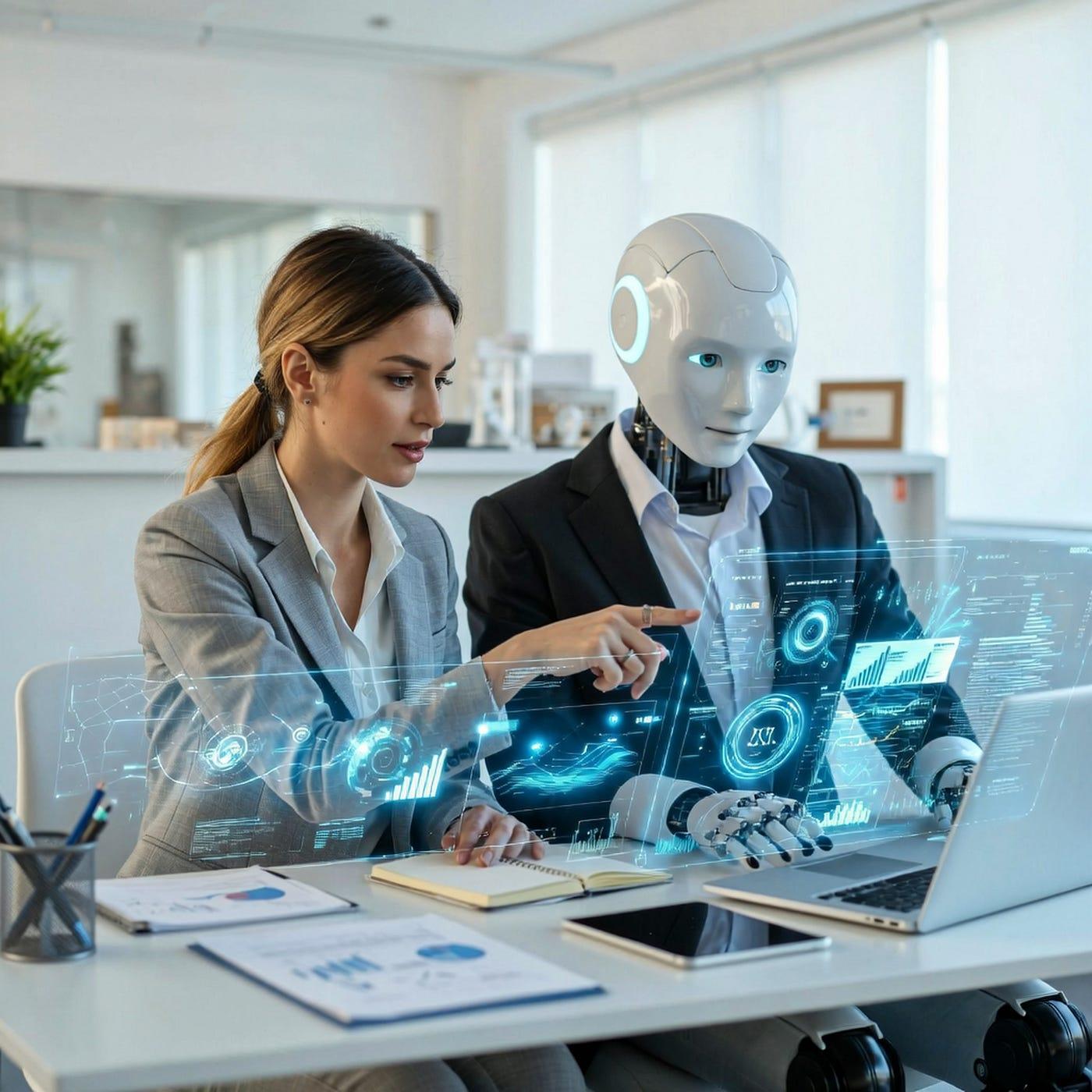
The future of work is changing. Artificial intelligence is moving beyond chatbots, content generation and individual productivity tools. AI agents are increasingly capable of interpreting objectives, coordinating activities, interacting with business systems and completing multi-step workflows. This creates a new question for business leaders: what happens when employees and AI agents become part of the same workforce? The answer is not simply more automation. It is a transformation in how organizations design jobs, structure teams, make decisions, manage performance and create value. This emerging model can be described as the Human-Agentic Workforce: a workplace where people and AI agents collaborate, with each contributing different capabilities.
What Is a Human-Agentic Workforce?
A Human-Agentic Workforce is an operating model in which employees and AI agents work together to accomplish business objectives. The goal is not to create a workforce where AI replaces every human activity. The opportunity is to create a workforce where humans focus on uniquely human value while AI agents handle appropriate digital work.
| People contribute | AI agents contribute |
|---|---|
| Judgment, creativity and empathy | Speed, scale and continuous availability |
| Leadership and strategic thinking | Data processing and pattern recognition |
| Relationship management | Workflow execution and process coordination |
| Complex problem-solving and accountability | Consistent support across high-volume digital work |
Agentic AI Is More Than Automation
Traditional automation usually performs predefined actions according to specific rules. Agentic AI can operate differently. An AI agent may be able to understand an objective, gather information, decide what action to take, interact with tools, execute multiple steps, evaluate outcomes and escalate an exception.
That means organizations are moving from automating tasks toward redesigning work. Automating an existing process does not necessarily create the best future process, so businesses may need to rethink the entire workflow around the capabilities of both humans and AI.
How AI Agents Are Changing the Workplace
AI agents can influence almost every layer of an organization. At the individual level, employees can use agents to research information, prepare documents, analyze data, coordinate tasks and manage routine activities. Across teams, multiple agents can support different parts of a workflow while employees coordinate priorities, review outcomes and handle exceptions.
Across business processes, agents can connect systems and support activities that previously required several manual handoffs. At the organizational level, companies may begin designing roles around outcomes rather than individual tasks.
- Individual work: research, analysis, document preparation and routine coordination
- Team work: distributed workflow support, priority coordination and exception handling
- Business processes: connected systems and fewer manual handoffs
- Organizational design: roles structured around outcomes rather than activity lists
From Jobs to Outcomes
Many traditional jobs are organized around lists of activities such as updating records, preparing reports, sending emails, scheduling meetings, reviewing documents and processing requests. Agentic AI can increasingly support many of these activities.
Instead of asking what tasks an employee performs, organizations can ask what outcome the role is responsible for delivering. AI agents can support the activities required to achieve that outcome, allowing employees to spend more time on judgment, innovation, relationships and complex decisions.
"The defining question changes from ‘What tasks does this employee perform?’ to ‘What outcome is this role responsible for delivering?’"
The New Human-AI Collaboration Model
The future workplace is unlikely to be purely human or purely automated. It is more likely to be collaborative: a person defines objectives and provides judgment; an AI agent processes information and executes appropriate actions; a person reviews exceptions and makes high-impact decisions; and the agent continues routine workflow execution.
This creates a continuous interaction between people and digital systems. The central design challenge is setting the boundaries correctly.
- A human defines the objective and provides context and judgment.
- An AI agent processes information and executes authorized actions.
- A human reviews exceptions and makes high-impact decisions.
- The AI agent continues routine workflow execution within its guardrails.
Five Shifts for the Human-Agentic Workforce
Building a Human-Agentic Workforce requires more than deploying new tools. It changes how organizations think about technology, jobs, capacity and change.
- From technology-centered to human-centered AI: begin by asking how AI can increase human capability and improve business outcomes, not where an agent can be deployed.
- From tasks to outcomes: redesign roles around measurable results rather than long lists of manual activities.
- From traditional operating models to AI-enabled operations: integrate digital agents into workflow design, accountability, decision-making, governance, performance management and technology architecture.
- From headcount scaling to intelligent capacity: use suitable digital capacity to absorb repetitive and high-volume activities while people focus on higher-value work.
- From change management to continuous adaptation: give employees continuing opportunities to learn how to use AI, evaluate outputs, manage exceptions and develop new skills.
What Skills Will Matter?
As AI takes on more routine execution, the skills that differentiate human workers may evolve. People remain essential when situations require context, ethics, experience, accountability, communication and decisions that do not fit established patterns.
Some employees may increasingly orchestrate multiple AI tools or agents to achieve business objectives. They will need to understand how the systems work, recognize their limitations and use them responsibly.
- Critical thinking to evaluate AI recommendations
- Problem-solving for unfamiliar situations and exceptions
- Communication, negotiation, leadership and relationship skills
- AI literacy and awareness of system limitations
- AI orchestration across tools and agents
- Judgment for high-impact, contextual and ethical decisions
The Rise of the AI-Enabled Employee
The future employee may not simply use software. They may work with a collection of specialized digital agents. A sales professional, for example, could receive support from agents that research prospects, analyze accounts, prepare meeting briefs, update CRM records, draft follow-up messages, monitor opportunities and surface relevant customer insights.
The salesperson remains responsible for relationships and strategic decisions while the agents provide additional capacity. This creates a digital workforce layer around the human workforce.
AI Agents and Organizational Productivity
The productivity opportunity comes from combining human judgment with machine scale. AI agents can operate rapidly across large volumes of digital information while people focus on activities where context and judgment matter.
Potential improvements include faster workflows, less administrative work, shorter response times, greater consistency, more employee capacity, improved information access and faster decision support. Productivity should be measured through actual business outcomes—not simply the number of AI tools deployed.
| Value area | Measures to track |
|---|---|
| Speed | Workflow cycle time and response time |
| Quality | Consistency, accuracy and rework |
| Capacity | Administrative hours reduced and employee time returned |
| Decisions | Information access and decision-support time |
| Business outcomes | Cost, customer experience and measurable operating results |
Trust Is a Workforce Requirement
Employees need to understand how AI is being introduced and why. Without trust, organizations may struggle to achieve adoption. A responsible model provides clarity about what AI is responsible for, what employees remain responsible for, how decisions are made, when human approval is required and how performance is monitored.
Organizations should also explain how employee data is handled and how errors are corrected. Trust is not simply an AI technology issue; it is an organizational issue.
Governance for Human-Agentic Work
As AI agents gain greater autonomy, governance needs to evolve. These controls help organizations introduce AI while maintaining operational accountability.
- Authority: define what an AI agent can decide
- Access: limit the systems and data it can use
- Accountability: name the person who owns the outcome
- Oversight: specify when human review is required
- Security: protect agents and connected systems from misuse
- Transparency: make AI-supported decisions understandable
- Monitoring: evaluate agent performance over time
Redesigning Management in the AI Era
Managers may need to coordinate people, AI agents and automated workflows rather than managing only people. Their responsibilities can include setting objectives, assigning work between humans and AI, monitoring performance, reviewing exceptions, managing risk, developing employee capabilities and improving workflows.
Management itself can therefore become more focused on orchestration and outcomes.
The Importance of Organizational Readiness
Technology can be deployed faster than organizations can adapt, creating a readiness gap. A strong technology platform alone is not enough. Businesses should assess the foundations that enable responsible AI-enabled work before scaling.
- Technology readiness: can existing systems support AI agents?
- Data readiness: is data accessible, accurate and governed?
- Process readiness: are workflows structured well enough to redesign?
- Workforce readiness: do employees have the skills to work with AI?
- Leadership readiness: can leaders redesign roles and operating models?
- Cultural readiness: does the organization support experimentation, learning and responsible adoption?
AI-First Operating Models
Instead of designing a process and then adding automation, companies can consider an AI-enabled operating model from the beginning. This means deciding what should be performed by people, AI agents and traditional software; where people and AI should collaborate; where human approval is required; and how performance should be measured.
These questions help organizations design work around capabilities rather than legacy structures.
How Businesses Can Prepare
Organizations do not need to redesign the entire workforce overnight. A practical approach starts with one focused workflow and expands only after its value, controls and employee experience have been tested.
- Identify high-value work: find processes that are repetitive, time-consuming, data-intensive or difficult to scale.
- Define the desired outcome: identify the improvement sought in productivity, speed, quality, customer experience, capacity or cost.
- Map human and AI responsibilities: decide which activities require human judgment and which can be supported by AI.
- Establish guardrails: define permissions, approval requirements, security controls and escalation procedures.
- Train employees: provide practical skills for working with AI agents.
- Measure results: track productivity, quality, cost, employee experience and business outcomes.
- Scale carefully: expand successful workflows while continuously monitoring performance and risk.
The Future of Work Is Human + AI
The conversation around AI and employment often focuses on replacement. A more useful business question is how organizations can redesign work so humans and AI contribute where each is most effective.
AI agents bring speed, scale and digital execution. People bring context, creativity, empathy, judgment, leadership and accountability. The future may not be about choosing between humans and machines, but about building organizations where they operate together as an integrated workforce.
The Efficacité Global Perspective
At Efficacité Global, we believe the next stage of AI transformation is not simply about adopting more technology. It is about reimagining work. Businesses need to rethink processes, roles, skills, operating models, governance and employee experiences as AI becomes increasingly capable of executing work.
The organizations preparing for this shift should design work around outcomes, keep humans at the center, give AI agents clearly defined responsibilities, build trust and governance into the operating model, and continuously develop the workforce.
The Human-Agentic Workforce is not simply a technology trend. It represents a new way of thinking about productivity, organizational design and the future of work. Organizations that prepare thoughtfully can create workplaces where AI expands human capacity rather than simply automating individual tasks. Talk to our team about preparing your organization for human-agentic work.
Key Takeaways
- ✓Human-Agentic Workforce design combines distinctly human capabilities with AI speed, scale and execution.
- ✓Agentic AI creates an opportunity to redesign work and end-to-end workflows, not only automate existing tasks.
- ✓Roles can be organized around measurable outcomes while agents support appropriate underlying activities.
- ✓Trust depends on clear responsibilities, human approval points, transparency, monitoring and data safeguards.
- ✓Managers and employees need new skills in AI literacy, orchestration, evaluation and exception handling.
- ✓Readiness spans technology, data, processes, workforce, leadership and culture.
- ✓Organizations should pilot focused workflows, measure real outcomes and scale carefully.
Frequently Asked Questions
What is a Human-Agentic Workforce?
A Human-Agentic Workforce is a working model where employees and AI agents collaborate to accomplish business objectives, combining human judgment and creativity with AI-driven execution and scale.
What is agentic AI in the workplace?
Agentic AI refers to AI systems capable of pursuing defined objectives, coordinating activities, interacting with software and executing multi-step workflows with a degree of autonomy.
How will AI agents change jobs?
AI agents can automate or support repetitive activities, allowing some employees to focus more on judgment, strategy, relationships, creativity and complex problem-solving.
Will AI agents replace human employees?
The impact will vary by role and process. AI agents can automate specific activities, while many roles can be redesigned around higher-value human capabilities and collaboration with AI.
What skills are important in an AI-enabled workforce?
Important skills include critical thinking, communication, problem-solving, AI literacy, judgment, collaboration and the ability to manage AI-enabled workflows.
What is an AI-enabled operating model?
An AI-enabled operating model integrates people, AI agents, automation, data, technology and governance into the way an organization delivers work and achieves business outcomes.
How can businesses prepare for AI agents?
Businesses can identify suitable workflows, define human and AI responsibilities, establish governance, train employees, measure outcomes and gradually scale successful AI implementations.
Why is human oversight important for AI agents?
Human oversight provides accountability and allows people to review high-impact decisions, handle exceptions, manage risk and intervene when an AI system operates outside its intended boundaries.
What is AI workforce transformation?
AI workforce transformation is the redesign of jobs, processes, organizational structures, skills and operating models to integrate AI into how work is performed.
About the author
Efficacité Global Team
AI Transformation, Workforce Strategy & Intelligent Operations
Efficacité Global partners with growing businesses and nonprofits across the U.S. and U.K. on CPA, tax, finance transformation, and outsourced operations. Our team publishes practical guidance drawn from live client engagements.
Talk to a CPA or consultant
Want to apply this to your business? Book a free 30-minute discovery call with an Efficacité Global partner and get tailored guidance for your next step.
Book a free consultation