

Managing accounts payable becomes more complex as companies grow. Higher invoice volumes, expanding supplier networks, multiple business entities, approval delays and manual processes can place significant pressure on finance teams. Accounts payable outsourcing services allow a business to assign selected AP activities to a specialist team while retaining control over financial policies, approvals, payment authority and strategic decisions. At Efficacité Global, AP support forms part of a broader approach to finance and accounting outsourcing, process management, automation and technology-enabled operations.
What Is Accounts Payable Outsourcing?
Accounts payable outsourcing is the practice of assigning specific AP activities to an external finance and accounting team. A business does not need to outsource the entire department: routine execution can be managed externally while financial decision-making and payment authorization remain internal.
The scope can include invoice processing and data capture, validation, purchase-order matching, approval workflows, exception management, vendor communication, statement reconciliation, payment preparation, reporting and document management.
Why Are Companies Outsourcing Accounts Payable?
As invoice volumes increase, manual AP processes become difficult to scale. Finance teams can spend substantial time entering data, checking documentation, following up approvals, investigating exceptions, answering vendor questions and reconciling supplier statements.
These activities matter, but they can reduce the time available for analysis, forecasting, planning and strategic decisions. Outsourcing can add processing capacity while introducing more consistent workflows and technology-enabled operations.
What Do Accounts Payable Outsourcing Services Include?
A comprehensive program can support multiple stages of the invoice-to-payment process.
| Service | Typical activities | Operational purpose |
|---|---|---|
| Invoice processing | Centralized intake, data capture and entry | Create a consistent process across channels |
| Validation | Check suppliers, invoice numbers, amounts, documentation, coding and duplicates | Prevent avoidable errors from moving downstream |
| Two-way and three-way matching | Compare invoices with purchase orders and receiving records | Identify discrepancies before payment |
| Approval workflows | Route by department, value, entity and authorization level | Improve approval visibility and follow-up |
| Exception management | Assign, track and resolve missing or conflicting information | Prevent invoices remaining unresolved |
| Vendor support | Handle invoice status, payment status, disputes and remittance queries | Reduce interruptions for internal teams |
| Reconciliation and reporting | Review supplier statements and report volumes, aging and performance | Improve record quality and management visibility |
Accounts Payable Outsourcing, Automation and AI
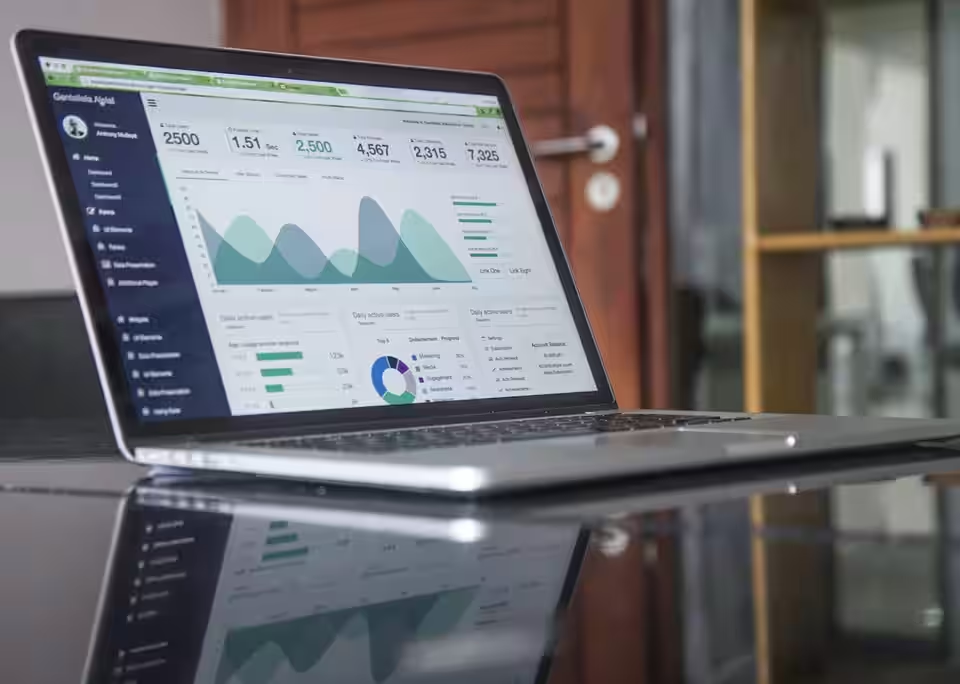
Outsourcing determines who performs the work; automation determines how the work is performed. A specialist team can operate an automated workflow while managing exceptions and activities that require human judgment.
AI can support invoice classification, data extraction, document processing, duplicate detection, matching, exception identification, workflow analysis and reporting. Human oversight remains important for unusual transactions, disputes, policy decisions and financial controls.
"People + Process + Automation + AI + Financial Controls"
Benefits of Accounts Payable Outsourcing
A well-designed model can improve the operating system around AP, not only its processing capacity.
- Improved efficiency through standardized workflows and less repetitive manual work
- Scalable capacity as invoice volumes and business requirements change
- More consistent processes across departments, entities and locations
- Greater visibility into approvals, exceptions, aging and liabilities
- Reduced administrative pressure on internal finance teams
- More consistent vendor support
- Access to automation, analytics and AI-enabled operations
Accounts Payable Outsourcing vs. In-House AP
There is no universal model. Many businesses use a hybrid approach: finance leaders retain payment authorization, cash management, policy, risk and approvals while a specialist team manages processing, validation, matching, follow-up, exceptions, vendor inquiries and reporting.
| Area | In-house AP | Outsourced AP |
|---|---|---|
| Staffing | Internal employees | External specialists |
| Management | Internal | Provider-led or shared |
| Scalability | Depends on internal capacity | Flexible external capacity |
| Technology | Requires internal investment | May be included in the service model |
| Process expertise | Built internally | Access to specialist resources |
| Control | Direct internal management | Defined through governance and controls |
How Much Does Accounts Payable Outsourcing Cost?
There is no single price. Cost depends on monthly invoice volume, supplier and entity counts, transaction complexity, geographic requirements, integrations, automation, scope, reporting and service levels.
Common structures include per-invoice pricing, monthly fees, dedicated-resource models, volume-based pricing and customized managed services. Evaluate total operating cost and expected business value rather than the outsourcing fee alone.
How to Choose an Accounts Payable Outsourcing Provider

Selection should test finance expertise, operating fit, technology, governance, safeguards and the ability to scale.
- Finance expertise: look for AP experience with organizations of comparable complexity.
- Technology capability: confirm compatibility with ERP, accounting, procurement, automation and vendor systems.
- Process governance: define approvals, segregation of duties, vendor-master changes, payment controls and audit trails.
- Data security: review access controls, data handling, monitoring, incident response and applicable requirements.
- Scalability: test the model against seasonal peaks, acquisitions, new entities and higher volumes.
- Reporting: require transparent service levels and useful management information.
Important Accounts Payable KPIs
Define a baseline and use clear measures to evaluate the service and identify improvement opportunities.
| KPI | What it measures |
|---|---|
| Cost per invoice | Overall processing cost |
| Invoice processing time | Speed through the AP workflow |
| First-pass match rate | Invoices matched without intervention |
| Exception rate | Share requiring manual resolution |
| Approval cycle time | Time invoices wait for approval |
| Invoice aging | How long invoices remain outstanding |
| Vendor query resolution | Speed of supplier support |
| Duplicate invoice rate | Effectiveness of validation controls |
| Backlog | Outstanding invoices by age and status |
Common Accounts Payable Challenges
Recurring AP problems often point to issues in process, ownership, technology or controls—not simply insufficient headcount.
- Manual data entry and repeated administrative effort
- Approval bottlenecks and unclear ownership
- Duplicate invoices and weak validation
- Poor visibility into pending, disputed or due items
- High volumes of vendor communication
- Inconsistent processes across departments or entities
- Seasonal and unexpected volume spikes
When Should a Business Outsource Accounts Payable?
Outsourcing may be worth evaluating when invoice volumes and backlogs are growing, approval delays are common, internal capacity is difficult to scale, multiple entities increase complexity, or finance leaders want more time for strategic work. A business can begin with selected processes rather than transferring the full function.
How to Transition to Outsourced Accounts Payable
A successful transition requires more than transferring tasks.
- Review the current process: map how invoices enter, move through validation and approval, and reach payment.
- Identify bottlenecks: locate delays, errors, exceptions and manual work.
- Define responsibilities: separate retained decisions from delegated execution.
- Establish controls: document approval authority, payment responsibilities, segregation of duties, escalation and vendor-master controls.
- Integrate technology: connect ERP, accounting, procurement and automation systems.
- Set KPIs: define targets for cost, quality, processing time, exceptions, backlog and vendor service.
- Continuously improve: use AP data to address recurring issues and identify automation opportunities.
The Future of Accounts Payable Outsourcing
The future of AP is increasingly connected to automation, AI, analytics, digital workflows and integrated financial systems. Modern operations can provide better visibility, more consistent data, earlier exception identification, improved workflow management and stronger controls.
The goal is not simply to process invoices faster. It is to build a finance operation that can scale, adapt and support better business decisions.
Accounts Payable Outsourcing with Efficacité Global
Efficacité Global approaches accounts payable outsourcing through people, process, technology and measurable outcomes. Support can cover invoice processing and validation, workflow management, vendor support, reconciliation, exceptions, reporting, process optimization, automation and AI-enabled finance operations.
The objective is to reduce repetitive administration while improving visibility, consistency, scalability and process performance. Explore our finance and accounts outsourcing services, read our guide to modern AP compliance and automation, or schedule a conversation.
Key Takeaways
- ✓Outsource suitable execution activities while retaining payment authority, policy and accountability internally.
- ✓Combine specialist delivery with standardized processes, automation, AI and clear financial controls.
- ✓Choose a provider based on expertise, technology fit, governance, security, scalability and reporting.
- ✓Compare total operating cost and business outcomes rather than fees alone.
- ✓Establish baselines and measure cost, speed, quality, exceptions, backlog and vendor service.
- ✓Transition in controlled stages with explicit responsibilities and continuous improvement.
Frequently Asked Questions
What is accounts payable outsourcing?
Accounts payable outsourcing uses an external finance team to manage selected or complete AP processes, including invoice processing, validation, matching, approval support, vendor communication, reconciliation and reporting.
What are accounts payable outsourcing services?
Services can include invoice processing, validation, purchase-order matching, approval workflows, exception handling, vendor support, reconciliation, payment preparation and reporting.
What are the benefits of outsourcing accounts payable?
Potential benefits include scalable processing capacity, standardized workflows, less manual work, improved visibility and access to specialist finance resources.
Can small and mid-sized businesses outsource accounts payable?
Yes. The appropriate model depends on transaction volume, internal resources, technology, financial complexity and growth plans.
How does AI improve accounts payable?
AI can assist with classification, data extraction, matching, duplicate detection, exception identification, workflow analysis and reporting while people handle judgment and control.
What is the difference between AP outsourcing and AP automation?
Outsourcing determines who performs defined activities; automation uses technology to reduce manual work. Organizations can use either approach or combine them.
How much does accounts payable outsourcing cost?
Cost depends on invoice volume, scope, complexity, technology, geography, reporting requirements and the agreed commercial model.
How do you measure AP outsourcing performance?
Common measures include cost per invoice, processing time, first-pass match rate, exception rate, approval time, aging, vendor query resolution and backlog.
Is accounts payable outsourcing secure?
Security depends on the client and provider controls. Businesses should evaluate access, data protection, segregation of duties, payment controls, monitoring and auditability before outsourcing.
About the author
Efficacité Global Team
Finance Operations & Accounts Payable Transformation
Efficacité Global partners with growing businesses and nonprofits across the U.S. and U.K. on CPA, tax, finance transformation, and outsourced operations. Our team publishes practical guidance drawn from live client engagements.
Talk to a CPA or consultant
Want to apply this to your business? Book a free 30-minute discovery call with an Efficacité Global partner and get tailored guidance for your next step.
Book a free consultation