

The finance function has traditionally been measured by accuracy, compliance, financial reporting, and control. Those responsibilities remain essential, but they are no longer enough. Today's finance leaders are being asked to close the books faster, provide better business visibility, improve forecasting, manage increasing complexity, adopt artificial intelligence, support acquisitions, strengthen controls, and help executives make better decisions. That is changing the role of the controller. The modern controller is no longer simply the owner of historical financial information - the role is evolving into a strategic finance leadership position that connects financial data, technology, processes, controls, and business performance. At Efficacité Global, we see this transformation as a progression: build the foundation, automate the work, activate intelligence, and continuously optimize.
Why the Traditional Finance Model Is Under Pressure
Many finance organizations still depend on processes that were designed for a different era. When finance professionals spend significant time collecting information, reconciling systems, preparing reports, and correcting exceptions, less time remains for analysis and strategic business partnership.
These challenges do not necessarily mean the finance team is underperforming. Often the problem is the operating model itself. The objective of finance transformation is not simply to introduce another technology platform, but to redesign how finance works.
- Manual reconciliations
- Spreadsheet-heavy reporting
- Disconnected financial systems
- Email-based approvals
- Repetitive journal entries
- Manual invoice processing
- Lengthy month-end close cycles
- Limited real-time reporting
- Fragmented data
- Reactive forecasting
What Is a Modern Controller?
A modern controller combines the discipline of traditional controllership with the capabilities of technology-enabled finance. The role increasingly spans five areas: financial control, process excellence, technology enablement, business intelligence, and strategic business partnership.
Controllers remain responsible for accurate financial information, compliance, governance, risk management, and strong internal controls. At the same time, they evaluate how finance processes operate across record-to-report, procure-to-pay, order-to-cash, planning, reporting, and close management - and they use automation, AI, workflow platforms, and analytics to reduce manual work.
The result is a finance function that does not just report performance. It helps improve it.
- Financial control - accuracy, compliance, governance, and internal controls
- Process excellence - end-to-end finance process design and ownership
- Technology enablement - automation, AI, workflow, and integrated systems
- Business intelligence - explaining why performance changed and what happens next
- Strategic business partnership - supporting the CFO, executives, and business units
Finance Transformation Starts With the Process, Not the Technology
One of the most common mistakes in digital finance transformation is starting with a technology purchase. Which AI platform, which automation tool, and which ERP are important questions, but they should come later. The first question should be: how does the finance process work today?
Once current processes, ownership, dependencies, controls, data flows, and exceptions are understood, organizations can determine which activities should be standardized, automated, augmented with AI, outsourced, or redesigned. This process-first approach prevents organizations from simply automating inefficient processes.
- Current processes and process ownership
- Technology dependencies and manual activities
- Control points and approval requirements
- Data flows and reporting requirements
- Exceptions and performance metrics
"Automating an inefficient process only makes the inefficiency run faster."
AI in Finance: From Experimentation to Practical Value
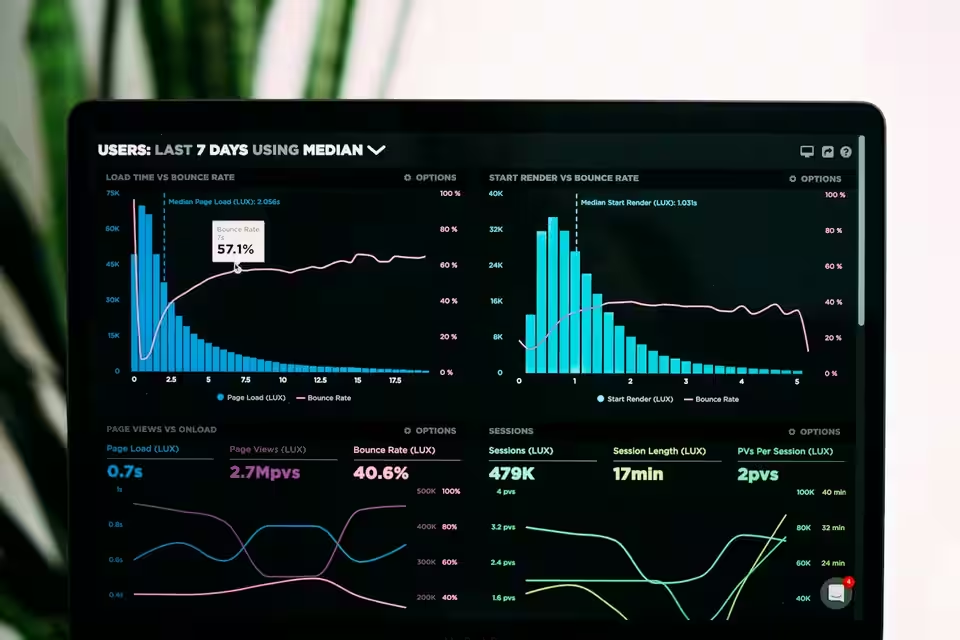
Artificial intelligence is becoming an increasingly important component of modern finance. But successful adoption is not about using AI everywhere - it is about identifying where AI can produce measurable business value.
The most effective model is not AI replacing finance professionals. It is AI allowing finance professionals to spend more time on higher-value work.
- Financial reporting - narrative reporting, variance explanations, and management reporting
- Anomaly detection - identifying unusual transactions and patterns for human review
- Accounts payable - document processing and workflow routing
- Forecasting - identifying patterns across historical and operational data
- Reconciliations - comparing transactions across systems and surfacing exceptions
- Management insights - dynamic performance analysis instead of static reporting
Automate the Work Around the Decision
Automation is most valuable when it removes friction from the finance operating model. Consider the traditional month-end close, where teams may spend days collecting information, downloading reports, reconciling accounts, following up with stakeholders, investigating exceptions, updating spreadsheets, and preparing management reports.
A transformed process connects systems, automates workflows, standardizes reconciliations, routes exceptions, and provides dashboards that show close progress in real time. Instead of asking where the data is, the team can focus on what the data is telling us - and what the business should do next.
The Controller's Role in M&A and Business Growth
Finance transformation becomes particularly important when organizations grow through acquisitions. New entities may bring different accounting systems, chart-of-account structures, reporting calendars, controls, processes, data structures, and technology platforms.
Without a scalable finance operating model, acquisitions can increase complexity faster than the organization can manage it. Controllers play an important role in creating consistency across the combined organization. The goal is not simply to integrate accounting systems - it is to create a finance operating model that can scale with the business.
- Standardized processes across entities and business units
- Consistent controls that support financial integrity and compliance
- Integrated reporting for a single view of performance
- Scalable technology connecting ERP, workflow, and analytics
- Automation to absorb additional entities and transaction volume
From Historical Reporting to Forward-Looking Finance

Traditional reporting answers what happened. Modern finance should also answer why it happened, what is likely to happen next, where the risks and opportunities are, and what actions can improve the outcome.
A modern finance dashboard brings performance into one view so executives gain timely visibility instead of waiting for a reporting cycle. This enables finance to become a decision-support function rather than only a reporting function.
- Revenue, gross margin, and operating expenses
- Cash flow and working capital
- Accounts receivable and accounts payable
- Forecast accuracy and close status
- Productivity and business-unit performance
Building a Modern Finance Operating Model
A successful finance transformation requires more than isolated automation projects. Organizations need an operating model that connects people, processes, technology, governance, and data. We approach finance transformation through four connected stages.
- Foundation - process assessment, standardization, controls, KPI definition, governance, reporting cadence, and clear roles.
- Automation - accounts payable workflows, invoice processing, reconciliations, approvals, data entry, reporting, exception management, and close activities.
- Intelligent finance - predictive analytics, AI-assisted reporting, anomaly detection, forecasting, dashboards, and decision support.
- Continuous optimization - tracking process performance, automation rates, cycle times, cost to serve, error rates, control effectiveness, and forecast accuracy.
| Stage | Primary focus | Typical outcome |
|---|---|---|
| Foundation | Standardize processes, controls, and governance | A consistent, well-owned finance process baseline |
| Automation | Remove repetitive, high-volume manual work | Lower effort, higher consistency, better visibility |
| Intelligent finance | Apply analytics and AI to stronger data | Insight and forecasting rather than information |
| Continuous optimization | Measure and improve continuously | Transformation becomes an ongoing capability |
What Finance Leaders Should Do Next

Organizations do not need to transform every finance process simultaneously. A more practical approach is to prioritize the areas where transformation can produce measurable value.
- Map the finance value chain and understand how transactions move through the organization.
- Identify friction - processes that are manual, repetitive, slow, expensive, or error-prone.
- Quantify the opportunity in time, cost, risk, volume, and productivity.
- Prioritize automation for standardized, high-volume, rules-based, measurable processes.
- Strengthen data and controls, because automation and AI depend on reliable data.
- Introduce AI where it creates value, focusing on practical use cases.
- Measure outcomes that matter to the business, not just the number of processes automated.
The Future of Finance Is Human Plus Digital
The future finance organization will not be defined simply by how much technology it uses. It will be defined by how effectively technology, people, processes, and data work together.
Automation can handle repetitive activities, AI can identify patterns and generate insights, analytics can make performance visible, and governance can protect the organization. But finance professionals remain essential for judgment, accountability, interpretation, and strategic decision-making. The modern controller becomes the orchestrator of all these capabilities.
Finance Transformation Is a Business Transformation
The biggest opportunity is not reducing the number of spreadsheets, shortening the close, or implementing another AI tool. It is building a finance organization that can keep pace with the business.
Efficacité Global helps organizations transform finance through process redesign, intelligent automation, analytics, governance, and scalable operating models across record-to-report, procure-to-pay, order-to-cash, FP&A, shared services, reporting, and AI enablement.
- Faster - streamlined processes and shorter reporting cycles
- Smarter - analytics and AI-supported decision-making
- More controlled - stronger governance and standardized processes
- More scalable - operating models designed for growth and acquisitions
- More strategic - finance focused on performance rather than administration
Key Takeaways
- ✓The modern controller is a strategic finance leader connecting data, technology, process, controls, and business performance.
- ✓Start finance transformation with process understanding, not with a technology purchase.
- ✓Apply AI where it creates measurable value: reporting, anomaly detection, AP, forecasting, and reconciliations.
- ✓A scalable finance operating model is what allows growth and acquisitions to be absorbed without added complexity.
- ✓Transformation is continuous - measure cycle times, automation rates, cost to serve, and forecast accuracy over time.
Frequently Asked Questions
What is a modern controller?
A modern controller combines traditional controllership - accuracy, compliance, governance, and internal controls - with process design, technology enablement, analytics, and strategic business partnership. The role connects financial data to business performance rather than only reporting historical results.
How is a modern controller different from a traditional controller?
A traditional controller focuses primarily on accurate reporting, compliance, and control. A modern controller keeps those responsibilities while also owning process improvement, automation, data quality, analytics, and decision support for the CFO and business leaders.
What is finance transformation?
Finance transformation is the redesign of how finance operates: processes, technology, data, controls, governance, and the operating model. The objective is a finance function that is faster, more accurate, more scalable, and more useful to business decision-making.
Should finance transformation start with technology?
No. It should start with understanding current processes, ownership, controls, data flows, and exceptions. Buying technology first often automates inefficient processes instead of improving them.
Where does AI create the most value in finance?
Common high-value applications include narrative and variance reporting, anomaly detection, accounts payable document processing, forecasting support, reconciliations, and management insight generation.
Will AI replace finance professionals?
AI is better understood as a way to reduce repetitive work so finance professionals can spend more time on analysis, judgment, and business partnership. Accountability and interpretation remain human responsibilities.
How does finance automation shorten the month-end close?
Automation connects systems, standardizes reconciliations, routes approvals and exceptions, and provides real-time close dashboards. That removes much of the manual collection and follow-up work that extends close cycles.
Why does M&A make finance transformation more urgent?
Acquisitions add different systems, chart-of-account structures, calendars, controls, and processes. Without a scalable operating model, complexity can grow faster than the finance team can absorb it.
What metrics should finance transformation be measured on?
Useful measures include close cycle time, reporting speed, automation rate, cost to serve, error and exception rates, control effectiveness, forecast accuracy, and finance productivity.
How can Efficacité Global help modernize our finance function?
We assess current finance processes, identify automation opportunities, redesign the finance operating model, strengthen governance and data, and build a practical roadmap for AI-enabled finance transformation tied to measurable outcomes.
About the author
Efficacité Global Team
Finance Transformation & Intelligent Automation
Efficacité Global partners with growing businesses and nonprofits across the U.S. and U.K. on CPA, tax, finance transformation, and outsourced operations. Our team publishes practical guidance drawn from live client engagements.
Talk to a CPA or consultant
Want to apply this to your business? Book a free 30-minute discovery call with an Efficacité Global partner and get tailored guidance for your next step.
Book a free consultation