
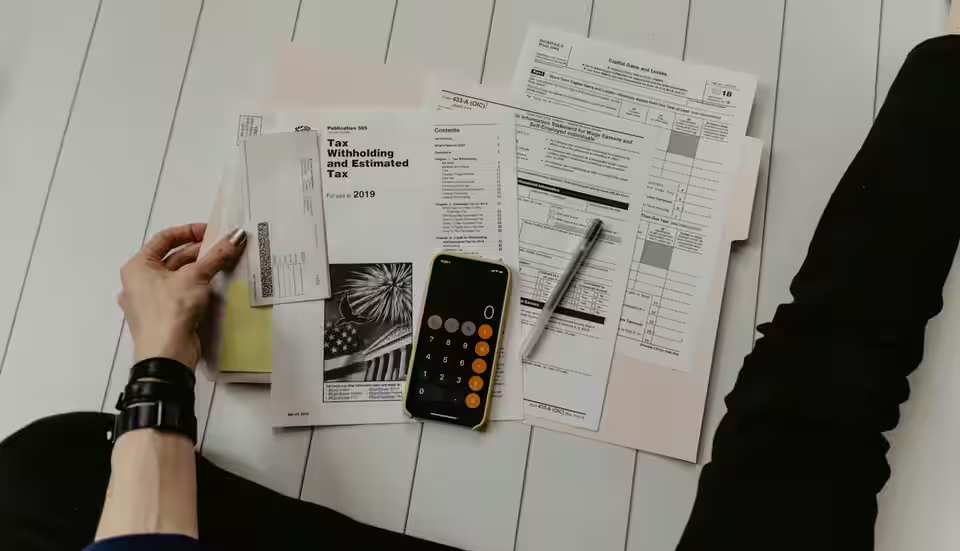
Receiving an envelope from the Internal Revenue Service with a CP2000 notice inside is enough to make any business owner or CFO pause. Formally known as the 'Notice of Proposed Adjustment for Underpayment/Overpayment', the CP2000 is not a formal audit, yet it is a significant legal signal. It indicates that the IRS automated matching system, the Information Returns Program, found a discrepancy between what you reported on your tax return and what third parties like banks, employers, or clients reported via 1099s and W-2s. For a small business, this often involves missing income from a merchant processor or a forgotten brokerage account.
The stakes are high because the IRS assumes their data is correct until you prove otherwise. If they believe you omitted $50,000 in gross receipts, they will calculate the tax on that full amount without considering your business expenses, plus add substantial interest and a 20 percent accuracy-related penalty. Responding to a CP2000 requires a calm, methodical approach. You generally have only 30 days to act before the IRS moves to formal collections or issues a 'Notice of Deficiency', which significantly limits your options for administrative resolution.
This guide details the exact steps every business leader should take upon receiving a CP2000. From verifying documents to drafting a professional rebuttal, understanding the nuances of IRS CP2000 notice response procedures is essential for protecting your company’s cash flow and maintaining your standing with federal authorities. Whether you are managing a growing startup or a sophisticated nonprofit, these five actions will help you navigate the process with minimal disruption.
Why This Matters: The Cost of Silence
A CP2000 notice is a high-volume tool used by the IRS to close the 'tax gap'. For a business owner, the financial implications of ignoring this notice are severe. Because the IRS calculates the proposed tax based on gross income without deductions, a notice proposing $10,000 in additional tax could easily be reduced to $500 or zero once legitimate business expenses are applied. However, if you do not respond, the IRS will default to the higher number. Moving quickly ensures you keep the conversation in the 'informal' stage, where resolution is much easier.
Beyond the tax itself, the IRS routinely attaches a 20 percent accuracy-related penalty under Section 6662 of the Internal Revenue Code if the underpayment is considered 'substantial'. For individuals and small business owners, this typically means an underpayment exceeding 10 percent of the tax required to be shown on the return, or $5,000, whichever is greater. These penalties, combined with interest that compounds daily, can turn a minor clerical error into a major financial liability. Management must treat a CP2000 as a priority item on the finance team’s agenda.
Step 1: Authenticate and Verify the Notice Details
The first action is to ensure the notice is legitimate and intended for your entity. Scammers frequently use fake IRS letterheads to solicit personal information. Verify that the notice contains your correct name, address, and Taxpayer Identification Number (TIN). If you are a corporation, check it against your EIN records. The top right corner of the first page should clearly list the notice number (CP2000), the tax year in question, and a specific contact phone number.
Once authenticated, look at the summary table. The IRS provides a column for 'Information on your return' and 'Information reported to IRS'. This is where you identify the 'mismatch'. Is it a 1099-K from a payment processor like Square or Stripe? Or is it a 1099-INT from a bank account you closed years ago? Identifying the source of the discrepancy is the only way to build a successful defense. Do not assume the IRS is right; internal errors at large banks often lead to duplicated 1099 filings.
Step 2: Reconstruct the Financial Paper Trail
Before drafting a response, gather your original tax return (Form 1040, 1065, or 1120), all supporting workpapers used by your accountant, and every 1099 or W-2 you received for that year. Check if the 'missing' income was actually reported, but perhaps on a different line item or under a different category. For example, business income sometimes gets reported on a Schedule E instead of a Schedule C, which can trigger an automated CP2000 even though the tax paid is correct.
If the income was truly omitted, you must determine if there are offsetting expenses. If you missed a $20,000 1099-NEC for a consulting project, you likely had travel, software, or subcontractor costs associated with that project. The IRS CP2000 only lists the $20,000 as pure profit. Reconstructing these expenses using your bookkeeping services software is the most effective way to lower the proposed tax bill. This step often requires deep-diving into bank statements from two to three years ago, as CP2000 notices usually lag behind the current filing year by 18 to 24 months.
Step 3: Determine Your Response Strategy (Agree vs. Disagree)
The CP2000 response form offers three choices: Agree, Disagree, or Partially Agree. If the IRS is 100 percent correct (e.g., you simply forgot to report a small savings account interest payment), checking 'Agree' and paying the amount is the fastest way to close the case. However, most business cases fall into 'Partially Agree' or 'Disagree'. For instance, if you sold stock and the IRS claims the entire sale price is gain because they don't have your cost basis, you must 'Disagree' and provide the purchase records.
A critical component of your strategy is deciding whether to file an amended return. While some notices suggest it, the IRS instructions for CP2000 often state that you should NOT file an amended return (Form 1040-X) for the items listed in the notice, as the CP2000 process is designed to handle those adjustments directly. Instead, you send the signed response form along with a detailed statement. If you find *other* errors on your return not mentioned in the CP2000, that is when a formal tax amendment becomes necessary.
"The CP2000 is not a bill; it is an invitation to explain. Treating it as an immutable invoice is the most common and costly mistake a taxpayer can make."
Step-by-Step Guide to Proposing a Correction
Efficiency is key during this window. If your business uses finance and accounts outsourcing, your external team should be able to generate the necessary ledger reports within 48 hours. Any delay in gathering data shortens your window for professional review. Take note of the 'Response Date' at the top of the notice; this is when the IRS needs to *receive* your letter, not when you should mail it. Use overnight delivery if you are within 3 days of the deadline.
- Download or photocopy the entire CP2000 notice to keep a clean record of what was originally proposed.
- Prepare a written explanation for each item the IRS flagged. Use a 'Fact-Law-Conclusion' format: state what happened, why the tax treatment was correct (or how it should be adjusted), and what the final number should be.
- Attach third-party evidence. This includes corrected 1099s from the issuer, bank statements, or copies of canceled checks. If the income belongs to someone else (nominee income), provide their name and TIN.
- Complete the CP2000 Response form. If you disagree, check 'I do not agree with some or all of the changes'. Ensure an authorized officer signs the form.
- Send the package via Certified Mail with Return Receipt Requested. Never send the only copy of your documents; send high-quality photocopies only.
- Follow up if you don't hear back within 30 to 60 days. The IRS will eventually send a CP2001 or CP2005 (Notice of No Change) to confirm the matter is resolved.
Comparison of Potential CP2000 Outcomes
Depending on your response, the outcome can vary significantly. Below is a breakdown of how different response types impact the finality and cost of the notice.
| Response Type | Immediate Cost Impact | Future IRS Interaction | Best For... |
|---|---|---|---|
| Total Agreement | High (Full Tax + Interest + Penalties) | Case Closed within 30-60 days | Simple, undeniable omissions. |
| Partial Agreement | Moderate (Adjusted Tax + Interest) | Review of documents; potential follow-up questions | Missing income with valid offsetting expenses. |
| Total Disagreement | Zero (if substantiated) | Extensive review; possible move to Appeals or Tax Court | Errors by the 1099 issuer or duplicate reporting. |
| No Response | Maximum (Assessment of full proposed amount) | Statutory Notice of Deficiency; Collections activities | Never recommended; leads to levies and liens. |
Common Mistakes to Avoid
The most frequent error is ignoring the notice because it 'looks wrong'. Many taxpayers assume that because they know they don't owe the money, the IRS will eventually figure it out. The IRS systems are set to 'auto-assess' if no response is received. Once the assessment is made, the debt moves to the collections division, where it becomes much harder to reverse. Always respond, even if your response is just to ask for more time or to state that the income was reported elsewhere on the return.
Another mistake is failing to check for state tax implications. The IRS shares information with state revenue agencies. If you agree to a CP2000 adjustment at the federal level, the state will eventually send their own notice for the same discrepancy. Proactive business owners should check their sales tax services and state income tax filings to ensure consistency across all jurisdictions once a federal adjustment is identified.
Finally, many taxpayers send a payment without the response form or send the form without a signature. Both actions delay the processing of your case and may result in the IRS thinking you haven't responded at all. Ensure every page of your response is stapled together and clearly marked with your TIN and the tax year.
Best Practices for Business Owners and CFOs
To prevent CP2000 notices in the future, implement a '1099 Reconciliation' process every January. Compare all 1099s received against your internal bookkeeping records before you file your annual return. If a 1099 is incorrect, contact the issuer immediately to have it voided or corrected. It is much easier to fix an error before the IRS receives the data than to dispute it two years later.
Maintain a dedicated 'IRS Correspondence' folder in your cloud storage. Store digital copies of every notice, every piece of evidence sent, and the proof of delivery. If you ever face IRS representation needs for a more serious audit, this history of compliance and organized record-keeping works in your favor. Furthermore, if your business has an international component, ensure your international tax services advisor reviews the CP2000, as omissions of foreign income or Form 8938 data can trigger much higher penalties ($10,000+) than standard domestic underreporting.
"Proactive reconciliation in January is the only way to effectively 'notice-proof' your business for the year ahead."
Real-World Example: The 1099-B Cost Basis Trap
Consider a small consulting firm that sold $200,000 in mutual fund investments to fund an expansion. The brokerage firm issued a 1099-B showing $200,000 in gross proceeds but failed to report the 'cost basis' (the price the firm originally paid for the shares) because they were acquired before 2011. The IRS issued a CP2000 claiming the firm owed tax on the full $200,000, resulting in a proposed bill of $70,000 including penalties.
The firm's CFO did not panic. They worked with their finance transformation team to pull the original purchase records from the firm's archives. They proved the shares were bought for $185,000. By responding to the CP2000 with these records, the taxable gain was reduced to $15,000. The final tax bill was less than $4,000, saving the company over $65,000 and the 20 percent penalty. This illustrates why the 'Information Reported to IRS' is often incomplete and must be challenged with internal data.
Conclusion: Taking Control of the Narrative
The IRS CP2000 notice is an automated tool, but your response must be human-driven and meticulously detailed. By following these five steps—verifying the notice, reconstructing records, choosing a strategy, providing evidence, and following up—you move from being a target of an automated system to a taxpayer in control of their financial narrative. The goal is not just to settle the bill, but to ensure you do not pay a penny more than you legally owe.
For complex cases involving transfer pricing, complex S-Corp structures, or large-scale contractor payments, involving a professional early is the most cost-effective move. Small business owners should leverage their S-corporation advisors to ensure the response is technically sound. Remember, the IRS is dealing with millions of these notices; the clearer and more professional your package, the faster it will be processed and closed, allowing you to get back to the core mission of your business.
"A well-documented response is your best defense against the IRS computer's assumptions. Accuracy wins every time."
Key Takeaways
- ✓The CP2000 is an automated proposal, not a final bill, so do not pay immediately if you suspect an error.
- ✓Standard deadlines are strictly 30 days, and missing them leads to the more difficult Notice of Deficiency phase.
- ✓Always compare the 'Information Reported to IRS' section against your internal bookkeeping records and original tax return.
- ✓Double-taxation often occurs in CP2000 notices when the IRS fails to account for cost basis in stock sales or business expenses against 1099 income.
- ✓Provide a clear, signed response even if you agree with the findings to stop the accrual of further interest.
- ✓Utilize professional tax planning to ensure all 1099s are tracked throughout the year, preventing future notices.
- ✓Maintain a digital and physical trail of all correspondence sent to the IRS via certified mail.
Frequently Asked Questions
Is an IRS CP2000 notice the same as a full tax audit?
No, the CP2000 is a 'Request for Verification' or 'Notice of Proposed Adjustment'. While it is often called a 'mail audit', it is an automated process and does not involve an in-person examiner unless the dispute remains unresolved for a long period.
How long do I have to respond to a CP2000 notice?
Usually, you have 30 days from the date printed on the letter. If you are currently living outside the United States, you are granted 60 days. If you miss this window, the IRS will issue a Statutory Notice of Deficiency.
Can I get an extension on the 30-day response deadline?
Yes, you can request an extension by calling the number provided on the notice. The IRS typically grants a 30-day extension if you explain that you are waiting for records or working with a tax professional.
Why did I receive this notice if I filed my taxes on time?
This usually happens when an employer or financial institution reports income to the IRS under your ID, but you didn't include it. Common examples include 1099-NEC for contract work or 1099-B for stock sales where the cost basis was missing.
What do I do if the IRS information is wrong?
Check the 'Response' section of the notice. You likely need to sign the 'Option 2' section (I do not agree) and provide a written statement with supporting documents like receipts or corrected forms. Do not file an amended return (Form 1040-X) initially unless the notice specifically tells you to.
What happens if I still disagree after the IRS reviews my response?
You have the right to appeal within the IRS Office of Appeals. If that fails, you will receive a Notice of Deficiency, giving you 90 days to petition the U.S. Tax Court. Professional help with IRS representation is highly recommended at this stage.
About the author
Nash Med, CPA
Managing Partner, Efficacité CPA & Tax Advisory
Efficacité Global partners with growing businesses and nonprofits across the U.S. and U.K. on CPA, tax, finance transformation, and outsourced operations. Our team publishes practical guidance drawn from live client engagements.
Talk to a CPA or consultant
Want to apply this to your business? Book a free 30-minute discovery call with an Efficacité Global partner and get tailored guidance for your next step.
Book a free consultation